
The Official VW Transporter Workshop Manual

Download the latest version of the VW Transporter workshop manual and Transporter T6 wiring diagram and receive over 10,500 pages of data, photos, illustrations, technical know how, troubleshooting and repair tips to help you out with any Transporter problem. This VW Transporter workshop manual is the same manual used by your local VW dealer, so why not cut out the middle man and attempt some DIY and save a considerable amount the money, along with gaining a sense of achievement.
Whatever the problem you may face, be it the common problem or even a electrical fault, this manual should be able to help you out, with your current difficulty or even future issues that will occur. Future proof any repair on your Volkswagen by downloading this Transporter T6 workshop manual.
Why do you need a VW Transporter T6 workshop manual?
Motoring is increasingly getting more and more expensive, alongside parts costs spiralling, labour charges set by your local dealer are also on the increase, and in most cases brunt most of the cost of a repair to your Transporter T6. By downloading this Volkswagen Transporter service manual and Transporter T6 wiring diagram, you can eradicate most of those costs, and depending on how confident you feel, our service manuals can remove all labour/service costs from your maintenance bill. It may be worth noting our manuals take you step by step through any repair, and assume that you (the owner), know little or nothing about auto mechanics.
Areas covered in this manual include General Information, Periodic Maintenance, Fuel System, Cooling System, Engine Lubrication System, Engine Removal & Installation, Crankshaft & Gearbox, Wheels, Tyres, Brakes, Suspension, Frame, Electrical System, Fault Finding, Traction Control, ABS and much much more.
What To Expect When You Download The Volkswagen Transporter workshop manual?
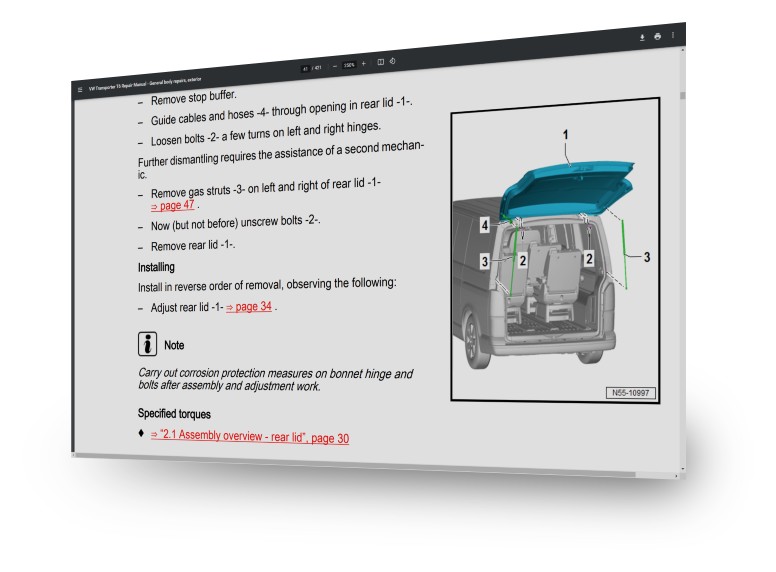
Our manual cover near every possible area of repair, service or repair on your van, although these manuals are used within VW to aid their mechanics with repairs, they are simple step by step instructions on how to get your car back on the road.
- General Information
- Common Specs and Procedures
- Accessories and Equipment
- Wheels and rims and tyres
- Air Conditioning & Heating
- Body
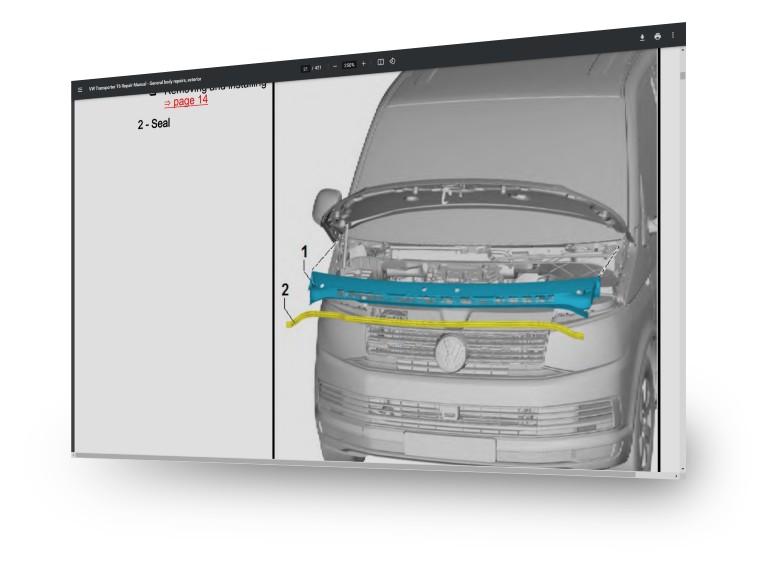
- Interior and exterior repair
- Brakes
- Driveline & Axles
- VW Transporter Wiring Diagram
- Engine
2.0 Diesel
2.0 Petrol - Radiator fan
- Brake system
- Convenience system
- Battery, starter and alternator
- Fuel system
- Reducing agent metering system
- Airbag systems
- Dual tone horn
- Heated rear window
- Fuses in engine compartment
- Fuses in interior
- Earthing concept in engine compartment
- Earthing concept in interior
- Headlights
- Electromechanical steering
- Steering column electronics
- Auxiliary air heater
- Seat heating
- Lane change assist
- Entry and start authorisation
- Heater
- Window wash/wipe system, headlight washer system
- Multifunction steering wheel
- Emergency call module
- Air conditioning system
- Anti-theft alarm system
- Parking aid
- Reversing camera
- Data bus network
- Sound system
- Adaptive cruise control
- USB charging sockets
- 12 V sockets
- Front camera for driver assist systems
- Mobile telephone systems
- Tail light clusters
- Light switch
- Dash panel insert
- Interior lights
- Multimedia system
- Background lighting
- Rear lid remote release
- Earthing concept in luggage compartment
- Steering wheel
- Automatic anti-dazzle interior mirror
- Driver assist systems
- Transmission / Gearbox
- Fuel Supply
- Servicing
- Plus much much more
- Lots of pictures & diagrams

FORMAT: PDF
LANGUAGE: English
PRINTABLE : Yes
PAGES : 11000 +
YEARS : 2011, 2012, 2013, 2014, 2015, 2016, 2017, 2018, 2019, 2020, 2021 onwards.
COMPATIBLE: All Operating Systems

What are the most common mechanical faults on the T5 and T6?
The “big three” that consistently come up are Exhaust Gas Recirculation (EGR) valves clogging, Diesel Particulate Filter (DPF) blockages from too many short journeys, and Dual Mass Flywheel (DMF) wear on higher-mileage manual models.
When should the cambelt and water pump be replaced?
For the 2.0 TDI engines, Volkswagen generally recommends a timing belt and water pump replacement every 130,000 miles or every 5 years, whichever comes first. Because it’s an interference engine, a snapped belt means catastrophic damage, so owners frequently ask to verify this exact interval.
How do I fix the P0401 fault code on my T6?
This code points to “Insufficient Exhaust Gas Recirculation Flow”. It means soot and carbon deposits have physically blocked the EGR valve. While cleaning it out sometimes works, replacing the unit is often the most reliable long-term fix.
Which engine oil does the 2.0 TDI actually need?
For diesel models on Longlife service intervals, the engine strictly requires oil meeting the VW 507.00 specification. Pouring in generic oil is a fast track to DPF failure. For fixed intervals, VW 504.00 is the standard.
Why is my DSG gearbox hesitating or jerking?
Usually, this is a symptom of overdue maintenance. The Direct-Shift Gearbox (DSG) requires fluid and filter changes strictly every 40,000 miles. Ignoring this interval leads to rough shifting and eventual wear on the mechatronic unit.
How do I force a DPF regeneration?
When the DPF warning light comes on, the easiest fix is taking the van for a sustained 30-minute drive at motorway speeds (keeping the revs over 2,000 RPM) to get the exhaust hot enough to burn off the soot naturally. If the filter is fully blocked, it requires a forced regeneration via an OBD-II diagnostic tool.
What is the “black death” issue on the injectors?
If there is a strong smell of diesel inside the cabin, the copper injector seals have likely failed. Left unchecked, exhaust gases escape and carbon builds up heavily around the injectors—a severe condition mechanics call the “black death”—which turns a relatively simple seal replacement into a difficult engine strip-down.
Why is water leaking in from the sliding side windows?
The factory sliding window seals on the T5 and early T6 are notoriously prone to shrinking or clogging with dirt and debris, which allows water to pool and leak into the cabin. Resealing the tracks or replacing the entire glass unit is the standard fix.
What is the difference between a T28, T30, and T32?
These numbers dictate the van’s Gross Vehicle Weight (GVW). A T28 has a maximum allowable weight of 2,800 kg, a T30 is 3,000 kg, and a T32 is 3,200 kg. This dictates exactly how much payload the van can carry and is a critical factor for people planning heavy campervan conversions.
Should I buy a T5, T6, or T6.1?
The choice usually comes down to budget and technology. The T5 (2003–2015) is the more analog, mechanical starting point. The T6 (2015–2019) introduced Euro 6 engines, AdBlue, and better refinement. The T6.1 (2019–present) overhauled the interior, switched to electromechanical steering, and added heavy digital and infotainment integration.
About the Transporter T6
The Volkswagen Transporter T6 is the sixth generation of the Volkswagen Transporter vans. It is the successor to the T5 Transporter. The Transporter line is the mid-size van offered by Volkswagen Commercial Vehicles, between the larger Crafter and smaller Caddy. ( Source )